Czech tax residency is a hidden gem in Europe. Many people don’t know that it’s one of the best places in Europe to establish yourself as a freelancers. The reason is that the country offers various options to lower your tax burden.
Overview of Tax Residency in Czech Republic
- Two tax brackets of 15% and 23%
- Exemptions for long-term capital gains
- Lump sum tax option for freelancers
- 60/40 method with 60% tax exemption for freelancers
- Social contributions for freelancers calculated after applying a correction factor lowering effective rates
- Corporate tax of 21%
Benefits of Czech Tax Residency
The main benefit of Czech tax residency is the low tax and contribution it offers for freelancers.
As a freelancer you can opt to pay a lump sum tax depending on your income range. This can allow you to pay as little as 6% in taxes and social contributions.
Another option is that you apply for the 60/40 method whereby 60% of your income remains exempt from income tax and social contributions. This allows you to pay an overall tax rate of around 15%.
We’ll discuss both options more in detail later on.
Taxes in Czech Republic
Let’s have a closer look at the different tax rates that apply in case of Czech tax residency.
Czech Personal Income Tax
The Czech Republic has two brackets for personal income tax:
- Net income <1.763.000 CZK: 15%
- Net income >1.763.000 CZK: 23%
The same rate applies to capital gains, dividends and interest.
However, if you meet certain holding periods (e.g. three years for listed securities), capital gains can be exempted from taxes.
That’s why we included the Czech Republic in our list of countries with no capital gains tax.
Furthermore, you can have your foreign dividends or interest taxed at a separate tax rate of 15%.
Lump Sum Taxation for Self-Employed Individuals
Self-employed individuals can opt for lump sum taxation under certain conditions.
The most important condition is that you only qualify if you have a revenue of less than 2 million Czech Korunas per year. Apart from this, other conditions apply.
Basically there are two categories of which you can be part under this regime depending on the income you generated (during the last year).
You fall within the first category if you made less than 1,5 million CZK. If you qualify for this category, you will pay a lump sum for income taxes and social contributions of around 7.500 CZK per month or 90.000 CZK per year.
Your actual tax rate will depend on how much you make but if you are just under the maximum threshold you’ll end up paying just 6% in taxes!
The second category is for people exceeding the first threshold but making less than 2 million CZK. In this category, your monthly lump sum payment equals to around 17.000 CZK per month or around 204.000 CZK per year.
In this case your effective lowest tax rate is just over 10%.
By applying for the lump sum taxation regime you can lower your tax rate massively as long as you don’t exceed the maximum income level.
It is nice to know that if you fall within the scope of this regime, you also don’t need to charge VAT. This is mainly an advantage is you work for clients who can’t claim back VAT, like private individuals.
The disadvantage of this system is that you don’t have to file a tax return and don’t receive an actual tax bill. Therefore, you can’t use these documents to prove your tax residency or income.
60/40 Method for Freelancers
The most popular setup is the 60/40 setup for freelancers.
This tax regime is called like that because it offers you the possibility to deduct 60% of your revenue as a lump sum cost deduction. Consequently, you only pay tax on 40% of your income.
Yet, there is a limit to this. You will only benefit from this lump sum cost deduction up to an amount of 2 million Czech Korunas.
This does not mean that if you make more than this amount, you can’t use this method. It just means that your revenue above that threshold will be taken into account in full to determine your tax rate.
After applying this lump sum cost deduction, the net result is subject to the standard tax rates. This means that if you have an income of up to 2 million Czech Korunas you will pay around 15% in total in income taxes and social contributions.
Social Contributions
For employees, the social contributions are split between the employee and the employer.
The employee pays 7,1% in social security and 4,5% for health insurance or a total amount of 11,6%.
The employer pays 24,8% in social security and 9% for health insurance or a total amount of 33,8%.
Thus, the total contributions for employees amount to a whopping 45,4%!
Social contributions for self-employed persons in Czech amount to 29,2% (1). However, this is calculated on 55% of your taxable income bringing the actual rate to around 16%.
Furthermore, you can opt to voluntarily join sickness insurance. The rate for the sickness insurance is 2,1%. This would bring the total rate to 31,3%.
However, on top of this you also need to pay health insurance contributions at a rate of 13,5%. These are calculated on 50% of your taxable income, halving the rate.
Note that the taxable basis is not necessarily your full income. If you are self-employed you can get lump sum cost deduction which will also lower the taxable basis for calculating your social contributions.
Furthermore, social security contributions are calculated on a maximum of 48 times the minimal wage, equaling around 2.350.000 Czech Korunas in total.
Corporate Tax in the Czech Republic
The corporate tax rate in the Czech Republic amounts to 21%.
However, when paying out a dividend another 15% withholding tax will apply and you need to include the income in your personal tax return.
Therefore, setting up a company in the Czech Republic is not recommended. It’s better to opt for one of the special regimes for freelancers.
Requirements to Become Tax Resident in Czech Republic
There are two ways to qualify as a tax resident of the Czech Republic;
- Spend 183 days in the country during the tax year
- Have a permanent home available in the country
If you want to meet the last requirement you can own or rent a place in the Czech Republic.
Most people opt for a rental at first. In that case, you’ll need special permission from your landlord to register yourself at their address for residency purposes.
How to Establish Tax Residency in Czech Republic
In order to establish tax residency in the Czech Republic you’ll need to take a few steps.
Obtain Residency Permit
The first step is to register with the Foreign Police in the Czech Republic within 30 days after your arrival.
As mentioned before, you need to have a rental agreement and declaration from the landlord in order to complete this step.
After you’ve done this you can apply for the Registration Certificate if you’re EU citizen.
For non-EU citizens, the Czech Republic is also a good option as they can obtain business visa or so-called freelance visa.
You have to apply for with the embassy of your country of registration. It’s valid for one year but you can keep renewing it as long as you keep your business registered in the Czech Republic.
Tax Registration
After getting your registration certificate you can also register yourself with the Czech tax authorities.
In addition, you’ll also have to register with the health and social authorities.
As a freelancer, you’ll also have to apply for a trade license in order to do business and potentially register for VAT.
Meet Criteria for Tax Residency
In order to qualify as a tax resident of the Czech Republic you need to meet one of the aforementioned criteria for tax residency:
- Spend 183 days in the country
- Have your center of vital interests there via a home
Tax Filing
The normal deadline for filing your tax return is 1 April of the following year.
Nevertheless, in certain cases you can get an extension of this deadline (e.g. working with a tax advisor).
My Perspective on Tax Residency in Czech Republic for Digital Nomads
If you just look at the general income tax rates in the Czech Republic, you might come to the conclusion Czech tax residency isn’t really interesting. Also the social contributions seem to be on the high side.
However, the Czech Republic does offer interesting regimes for freelancers that allow you to pay low taxes and contributions because of all the corrections that happen before calculating your taxes.
How is the Czech Republic for Digital Nomads?
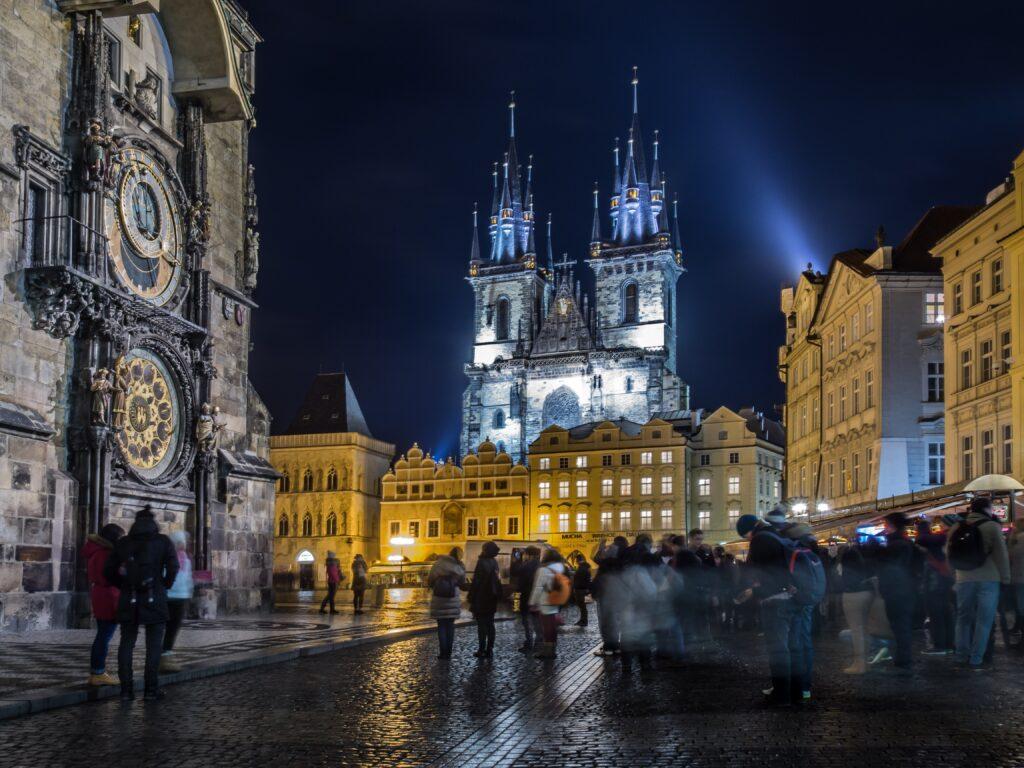
The Czech Republic is probably not the most popular destination for digital nomads.
Yet, cities like Prague and Brno have plenty of things to offer.
Furthermore, the infrastructure of the country is decent to work from.
Nevertheless, if you’re not a fan of the cold, there are probably parts of the year you might want to skip the Czech Republic.
Do You Want to Optimize Your Taxes? Work With Me
Over the past ten years, I have helped hundreds of nomads with optimizing their taxes.
Some of them choose for tax residency in the Czech Republic, while others were better of with other alternatives.
Do you need help for crafting a tailored plan that suits you? Reach out to me!